Calculated Change: Mortgages Go Digital

Helping Fannie Mae translate its digital transformation strategy into practical tools, stronger internal capabilities, and more customer-centered ways of working.

  • Client

    Fannie Mae

  • Role

    Design Director

  • Year

    2016-2017

Case Study

From Origination to Innovation

Fannie Mae is one of the largest and most influential mortgage finance companies in the U.S. Its standards and systems shape how mortgages move across the industry.

Moving from paper to digital therefore required more than a technology upgrade. It meant helping a broad network of lenders, servicers, warehouse lenders, and technology partners understand what was changing and adapt how they worked.

Fannie Mae engaged EY to support a broader digital transformation effort across its mortgage ecosystem. As a Design Director, I helped lead the strategy and design of tools, education, and self-service experiences that made the shift from paper-heavy processes to digital workflows clearer and easier to adopt.

Challenge

Shifting to a digital-first mortgage infrastructure required Fannie Mae to:

  • Help lenders, servicers, warehouse lenders, and technology partners navigate changes in how mortgages were originated, funded, delivered, and serviced
  • Create a more coherent experience across education, onboarding, tools, and support
  • Make operational, financial, legal, and technical requirements easier to understand and act on
  • Expand self-service while building the internal capabilities needed to sustain the change

A lender considering eMortgage had to understand how the change would affect its technology, operations, partners, and financial model. But the answers were spread across PDFs, FAQs, learning modules, calculators, job aids, announcements, and internal and external resources owned by different teams. Finding the right guidance meant knowing where to look, what applied to your institution, and how the pieces fit together.

The challenge was different for every participant in the mortgage process. Servicers, warehouse lenders, and technology partners had their own decisions to make and changes to implement. The fragmented experience slowed decisions, increased reliance on manual support, and made the transition harder for Fannie Mae to scale.

Solution

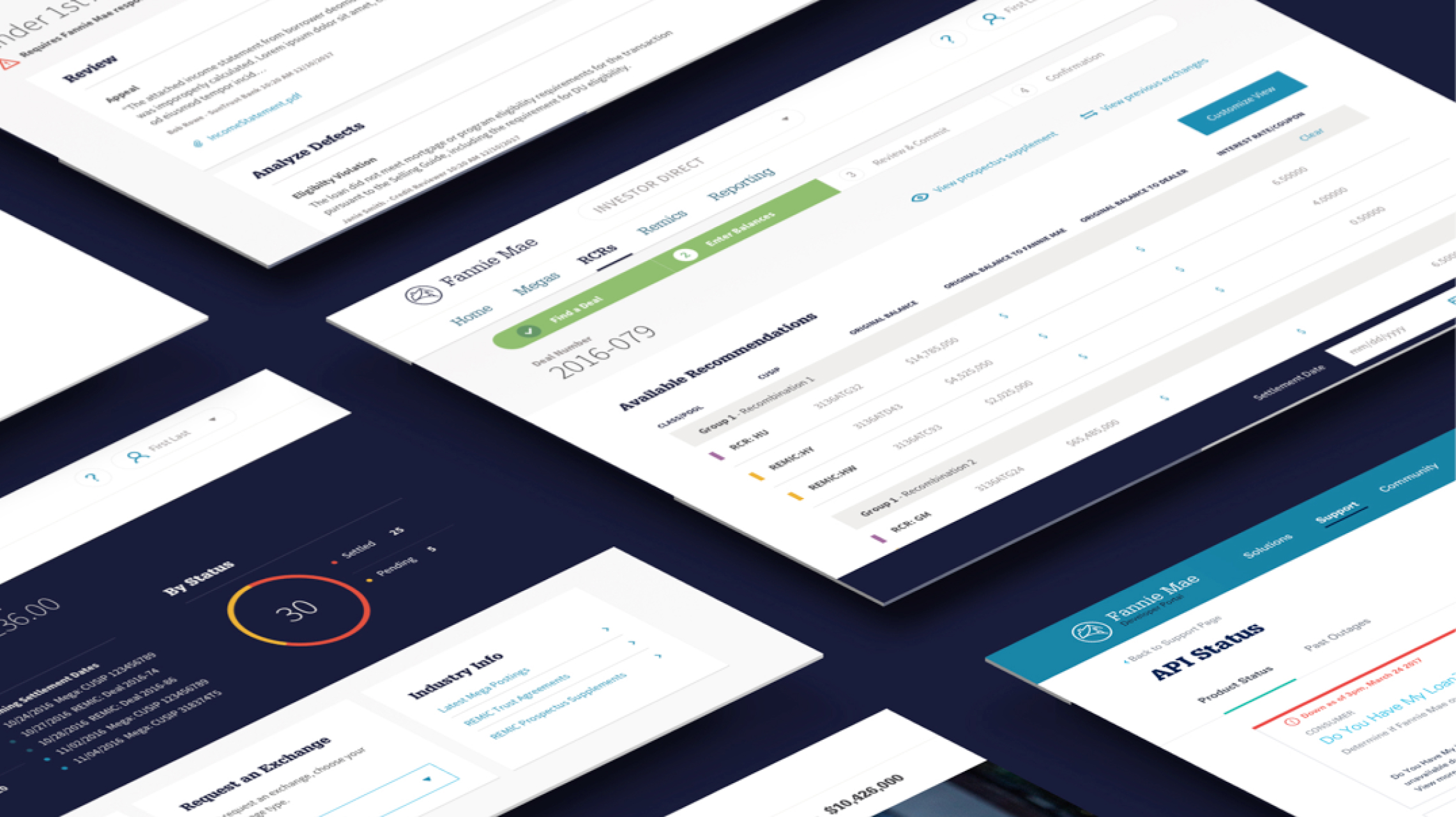
Within EY’s broader engagement, I led the design team across two connected efforts: a vision prototype for mortgage investment decisions and a new education experience for lenders and servicers. My role spanned research and synthesis, experience strategy, and hands-on design, including journey mapping, wireframing, visual design, motion studies, and prototype development.

Through stakeholder and industry research, competitive analysis, content review, and feedback on early concepts, we identified where audiences lacked context, struggled to interpret the information, and needed clearer guidance on what applied to them.

We then facilitated cross-functional working sessions to align teams around the portal experience, map service flows, prioritize content, and define how education, tools, onboarding, and support should work together.

The education experience reorganized fragmented guidance into a more coherent system for lenders, servicers, and other industry partners. Improved hierarchy, labeling, cross-linking, and personalization helped each audience find what applied to them and understand what to do next.

Adopting eMortgage required lenders and servicers to weigh potential efficiencies against the technology, process, and coordination required to implement it. The Digital Mortgage Calculator helped institutions assess that tradeoff using their own circumstances, guiding them through the decision with real-time feedback, customized paths, and summary views.

Strategy to Practice

The work connected Fannie Mae’s transformation strategy to the information, decisions, and organizational practices required to put it into operation.

For partners, the education experience and calculator made it easier to understand the transition, determine what applied to them, and assess the implications of adoption. For Fannie Mae, stronger self-service offered a more scalable way to support its partner network.

The shared information structure also gave product, technology, communications, customer experience, and support teams a more consistent way to organize requirements, align around service flows, and coordinate their work.

Building those internal capabilities was an important part of the broader EY engagement. To help them adopt a more holistic approach to human-centered design, we helped them create a Pop-Up Innovation Studio so that the see how human-centered design could be integrated into their work more holistically and valued as an organizational capability rather than a standalone service.

SERVICES

+ Experience Strategy
+ Research and UX Assessment
+ Service Design
+ Journey and Flow Mapping
+ Information Architecture
+ Content Strategy
+ Interaction Design
+ Prototyping
+ Visual Design
+ Motion Studies

Results

The work gave Fannie Mae a practical model for applying human-centered design to a major operational change. It showed how design could improve the partner experience, strengthen self-service, align internal teams, and become a more integrated organizational capability.

  • Made requirements, tools, and decision paths easier for partners to navigate
  • Created a more coherent experience across education, onboarding, tools, and support
  • Helped institutions assess the implications of eMortgage adoption
  • Strengthened Fannie Mae’s ability to apply human-centered design across teams
Impact & Takeaway

Large-scale transformation depends on more than introducing new technology.

It requires helping people understand the change, make informed decisions, work across organizational boundaries, and build the internal capabilities needed to sustain it.

More Work

Calculated Change: Mortgages Go Digital

Helping Fannie Mae translate its digital transformation strategy into practical tools, stronger internal capabilities, and more customer-centered ways of working.

Supporting Better Financial Advice

Modernizing the digital experiences behind a multi-trillion-dollar wealth management business.

Lights, Camera, Corporate Action: Inside A Media Company’s Event Video

Turning boardroom breakthroughs into blockbuster viewing for the team.

Calculated Change: Mortgages Go Digital

Helping Fannie Mae translate its digital transformation strategy into practical tools, stronger internal capabilities, and more customer-centered ways of working.

  • Client

    Fannie Mae

  • Role

    Design Director

  • Year

    2016-2017

View Project
Supporting Better Financial Advice

Modernizing the digital experiences behind a multi-trillion-dollar wealth management business.

  • Client

    Morgan Stanley

View Project
Lights, Camera, Corporate Action: Inside A Media Company’s Event Video

Turning boardroom breakthroughs into blockbuster viewing for the team.

View Project